Educational vision perception & optics guide

Educational Vision Science

How Human Vision Works

Optical Perception Digital Displays Visual Ergonomics Light Spectrum

Explore the biology of sight and the principles of visual comfort in a screen-first era. From light refraction to neural processing, discover how your eyes and brain work together.

Light Processing

Unpack how photons refract through the cornea, crystallize on the retinal canvas, and translate into neurological perception.

Focal Plane Dynamics

Analyze the sustained accommodation demands placed on ciliary muscles during prolonged interactions with digital monitors.

Ergonomic Illumination

Learn balanced contrast ratios, ambient workspace lumens, and glare reduction methods that foster visual ease throughout the day.

Educational Science09/14/2026

The Architecture of Human Vision: From Light Waves to Conscious Perception

Human sight is an intricate biological marvel. Every waking second, millions of electromagnetic vibrations pass through living optical elements, converting raw ambient illumination into vivid spatial comprehension within the brain.

1. The Optical Mechanics of the Eye (Cornea, Pupil, and Lens)

The journey of visual perception begins when light rays reflect off physical surfaces and reach the anterior segment of the human ocular structure. Before neural processing occurs, incoming rays must be precisely bent and focused onto the receptive tissue at the rear of the eye.
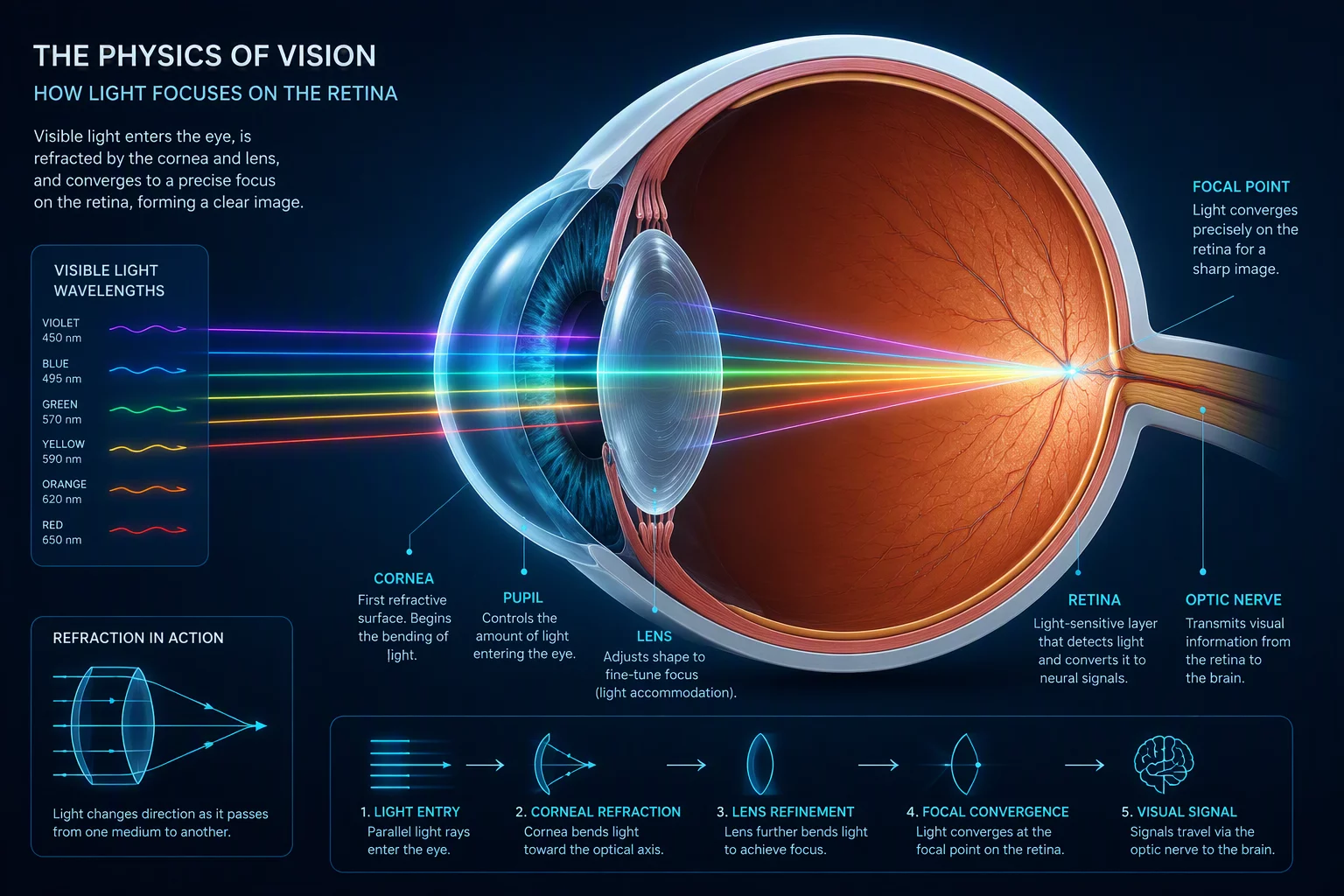
Diagram showing optical light refraction through cornea and lens

The process depends on three synchronized structural components:

  • The Cornea: A clear, dome-shaped outer window responsible for approximately two-thirds of the eye's total refractive optical power. It bends divergent light waves into a converging beam.
  • The Pupil and Iris: The dynamic aperture system. The pigmented iris adjusts pupillary diameter via muscular contractions, regulating light admission based on ambient brightness.
  • The Crystalline Lens: A flexible, biconvex structure situated directly behind the pupil. Controlled by ciliary bodies, it alters its focal curvature (accommodation) to sharply project near or distant objects onto the retinal plane.

Bio-Physical Phenomenon: Dynamic Focal Adaptation

The human crystalline lens can change optical focus from infinity to twenty centimeters within 350 milliseconds. It continuously recalculates minute refractive discrepancies without conscious mental direction.

2. Photoreception: How Rods and Cones Decode Wavelengths

Once focused photons strike the neural retina, physical electromagnetic energy undergoes transduction into electro-chemical signals. This critical translation is carried out by specialized photoreceptor cells populated across the retinal surface.

The human retina relies on two primary classes of photoreceptors, each engineered for distinct environmental conditions:

  • Rods (Scotopic Vision): Numbering over 100 million, rods exhibit extraordinary sensitivity to minimal photon quantities. They excel at detecting motion, contrast, and peripheral silhouettes under low-light conditions but do not distinguish chromatic hues.
  • Cones (Photopic Vision): Concentrated predominantly within the fovea centralis, approximately 6 million cone cells operate in well-illuminated environments. They provide high-acuity spatial resolution and tri-chromatic color identification.

Human trichromacy functions through three cone varieties tuned to distinct wavelengths: S-cones (short-wave blue ~420 nm), M-cones (medium-wave green ~530 nm), and L-cones (long-wave red ~560 nm). The brain synthesizes overlapping activation spectra into millions of discernible hues.

Illustration of light spectrum wavelengths and photoreceptor interaction

3. Neural Pathways: From Retina to the Visual Cortex

Transduced signals do not travel directly to consciousness; they undergo progressive compression and integration through several neurological layers before forming mental imagery.

  • Retinal Ganglion Cells: Integrate outputs from bipolar and horizontal cells, bundling over one million axons to form the optic nerve.
  • The Optic Chiasm: A pivotal crossroad where nerve fibers from the nasal hemiretinas decussate (cross over), allowing binocular data from both eyes to unite for stereoscopic depth calculation.
  • Lateral Geniculate Nucleus (LGN): Located in the thalamus, this relay station organizes visual information into distinct streams for movement, depth, color, and high-frequency details.
  • Primary Visual Cortex (V1 / Striate Cortex): Situated in the occipital lobe, V1 breaks down complex scenes into basic orientations, boundaries, angles, and spatial frequencies before broadcasting them to higher association areas (V2, V4, and MT).

Bio-Physical Phenomenon: The Visual Processing Relay

The human occipital lobe processes visual data in parallel streams. Motion is decoded milliseconds before color and form, enabling rapid reflex orientation to sudden shifts in the visual field.

4. Visual Adaptation and Environmental Balance

The visual system constantly stabilizes its output across wildly fluctuating ambient environments. Entering a dim auditorium from bright midday sunlight requires biochemical adjustments known as dark adaptation, driven by the regeneration of rhodopsin pigment molecules inside rod cells.

Likewise, balanced environmental ergonomics—such as diffuse indirect illumination, adequate ambient luminance, and frequent distance gaze shifts—help preserve comfortable visual processing throughout modern daily routines.

Core Insights

  • Refraction across the cornea and crystalline lens guarantees precise focal geometry upon the neural retina.
  • Photoreceptor division of labor allows high-resolution color discernment alongside acute low-light detection.
  • Visual perception is a synthesized reconstruction calculated across multiple specialized cortical regions.
  • Lighting harmony and thoughtful everyday visual habits encourage balanced perceptual comfort.
Educational Articles

Exploring the Visual Dimension

Deepen your understanding of visual perception, light mechanics, and daily environmental factors shaping comfort and focus.

Light and color frequencies in human visionOptics & Color
08/14/2026•5 min read

How the Human Eye Interprets Light and Color Frequencies

Discover how electromagnetic wavelengths transform into rich neural sensations of hue, contrast, and ambient brightness.

Visual ergonomics and screen usageErgonomics
08/22/2026•6 min read

Visual Load and Ergonomics in Screen-Heavy Environments

Analyze the subtle biomechanical demands of sustained digital gaze, monitor elevation, and visual field distribution.

Workplace illumination and visual comfortLighting Setup
08/30/2026•4 min read

Ambient Workplace Illumination and Visual Comfort

Explore the physics of balanced luminance, contrast ratios, and glare reduction across professional workspaces.

Smartphone display dynamics and reading habitsDisplay Habits
09/04/2026•5 min read

Smartphone Display Dynamics and Daily Viewing Habits

Examine handheld viewing angles, variable pixel densities, and rhythmic scrolling behavior during daily tasks.

Distance shifting and focal relaxation mechanicsFocal Dynamics
09/09/2026•6 min read

The Mechanics of Distance Shifting and Focal Relaxation

Unpack how ocular accommodation alternates between near horizons and distant focal depths to restore visual ease.

Spatial depth perception and binocular visionPerception Science
09/14/2026•5 min read

Spatial Awareness: Depth Perception and Binocular Vision

Investigate stereoscopic convergence, retinal disparity, and how our dual perspectives construct a seamless 3D reality.

Biological Insights

Fascinating Dimensions of Human Sight

Explore the sophisticated biological mechanics, neural mapping, and adaptive capabilities that power how human beings perceive light, motion, and visual space.

Trichromacy

Color Spectrum & Tristimulus Vision

Human trichromacy operates via three distinct cone types in the retina, sensitive to short, medium, and long wavelengths. The visual cortex continuously calculates ratios between red, green, and blue neural impulses to synthesize millions of perceptible hues.

200° Field

The Scope of Peripheral Vision

Binocular human sight spans nearly 200 degrees horizontally. Peripheral zones are dominated by rod photoreceptors, specifically tuned to detect rapid motion, subtle flickers, and ambient orientation cues long before central focus locks on an object.

Photokinetics

Dark & Light Adaptation Kinetics

Transitioning between ambient extremes relies on photopigment regeneration. While pupil dilation offers immediate adjustment, full chemical regeneration of rhodopsin in dim environments takes upwards of twenty to thirty minutes for optimal sensitivity.

Stereopsis

Depth, Parallax, & Motion Tracking

Slight horizontal disparity between the two retinas creates stereoscopic depth perception. Combined with motion parallax—where closer objects appear to move faster than distant ones—the brain renders a high-precision real-time 3D spatial map.

Mission & Philosophy

Visual Literacy for an Illuminated World

Virogeniceon is an independent educational publication dedicated to exploring how human vision interacts with modern environments, everyday optics, and digital technology.

Visual Literacy

Demystifying the intricate biology of the human eye, neural pathway processing, and how light transforms into sharp mental images.

Everyday Optics

Examining ambient luminance, color temperatures, reflections, and contrast balance across homes, workspaces, and natural daylight.

Screen Awareness

Investigating pixel density, refresh rates, display distances, and mindful habits to navigate intensive screen time effortlessly.

Mindful Ergonomics

Promoting conscious visual routines, periodic distance focusing, workstation angles, and sustainable spatial habits for everyday comfort.

Editorial Values

Clarity Through Reliable Science

Every article in Virogeniceon is rooted in verified optical principles, visual biophysics, and environmental research. We translate intricate perceptual physics into intuitive, accessible concepts to help readers cultivate thoughtful visual awareness without clinical jargon.

Empirical Foundations

Grounding all articles in peer-reviewed scientific studies and optical physics literature.

Accessible Educational Focus

Explaining complex visual mechanisms with structured formatting and clear illustrations.

Conscious Environmental Design

Encouraging practical adaptations to light, contrast, and distance in everyday life.

Visual Optics & Science

Frequently Explored Questions About Vision

Educational insights exploring how the visual system processes illumination, maintains focus, and interprets spatial depth in everyday environments.

The retina contains three types of cone cells sensitive to blue, green, and red wavelengths. When light hits these cones, they send signals in different proportions. The brain combines these signals to produce millions of distinguishable colors.

In bright light, the photopigment rhodopsin in rod cells gets bleached. When you enter a dark space, it takes 20-30 minutes for rhodopsin to regenerate and restore full sensitivity. The pupil widens quickly, but full chemical adaptation is a slower process.

The ciliary muscle reshapes the crystalline lens to focus at different distances. For far objects, the muscle relaxes and flattens the lens. For near objects, it contracts and rounds the lens, increasing refractive power for sharp close-up vision.

Peripheral vision covers the wide area outside your direct focus. It relies on rod cells that excel at detecting motion and changes in brightness. This allows you to sense movement and navigate spaces without looking directly at every object.

Large brightness differences between your screen and surroundings force the eye into constant adjustment, causing fatigue. Soft, diffuse ambient lighting that matches screen brightness reduces glare and keeps viewing comfortable.

Staring at a screen keeps the ciliary muscles constantly tensed. Looking at distant objects (6+ meters away) lets these muscles relax. It also restores natural blinking, which helps keep the eyes moist.